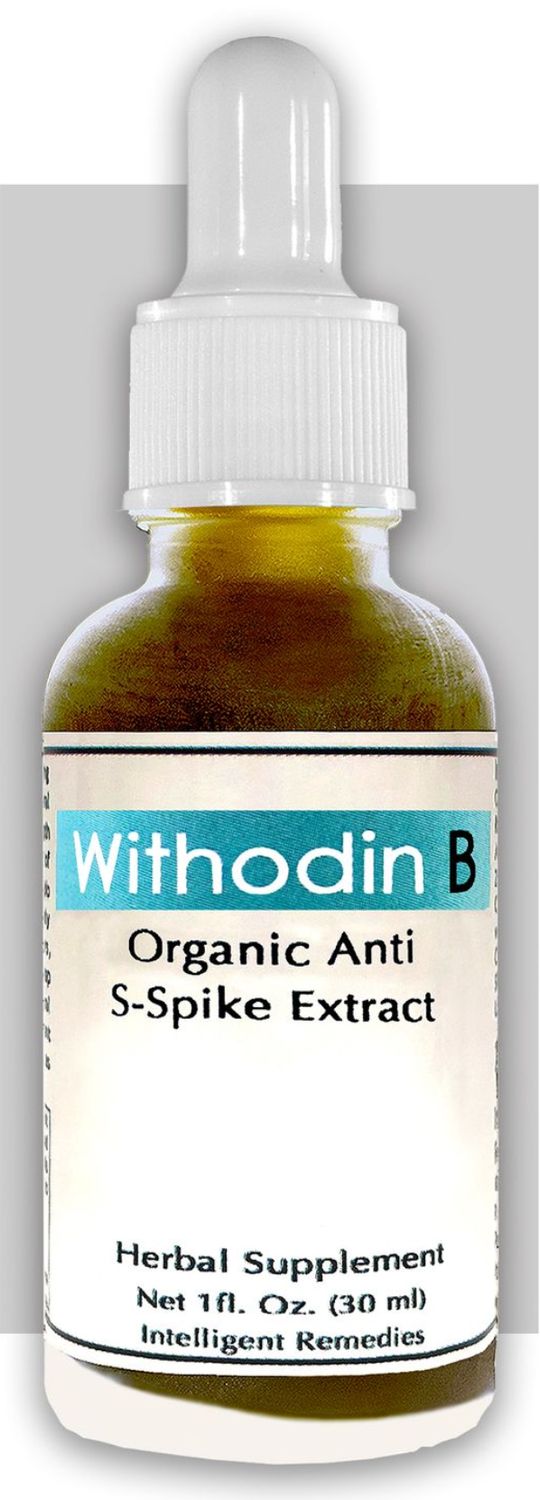
WITHODIN B™ — Phytotherapeutic S‑Spike Inhibition Support
Support Your Viral‑Interface Defense with Withodin B™
Withodin B™ is a concentrated herbal extract blend formulated for supportive modulation of the SARS‑CoV‑2 spike (S) protein–ACE2 interaction and related viral protease targets. Prepared using advanced extraction and proprietary protocols, the formula combines botanicals and supportive actives selected for predicted S‑spike–interfering and antiviral properties.
WHAT’S INSIDE?
A targeted blend of extracts and actives chosen for antiviral and immune‑supportive potential:
Withania somnifera (Ashwagandha)
Adaptogenic root extract containing withanone and withaferin A; computational and preclinical studies suggest these compounds can bind the ACE2–RBD interface and target viral proteases.
Polygonum multiflorum (Chinese Knotweed / He Shou Wu)
This polyphenol-rich extract is valued in traditional Chinese medicine for its antioxidant activity and ability to support cellular proteostasis. Often associated with promoting longevity and vitality, He Shou Wu is also believed to enhance hair health and overall well-being.
Apis mellifera Propolis (Bee Propolis)
Propolis, a natural resin produced by bees, is rich in flavonoids and phenolics with broad-spectrum antimicrobial and immune-modulating properties. It supports barrier defenses and contributes to local antiviral activity, making it essential for overall immune resilience.
Camellia sinensis (Green Tea)
Known for its high catechin content, particularly EGCG, Green Tea extract offers strong antioxidant effects and supports immune function. Its antiviral properties and protein-stabilizing effects contribute to overall cellular health and are linked to improved metabolic rates and cardiovascular well-being.
Monoatomic Gold (Au)
This trace mineral preparation is claimed to provide modulatory and stabilizing effects in targeted formulations. It is believed to enhance cognitive function and energy flow, promoting greater clarity and overall well-being.
Cinnamomum verum (Ceylon Cinnamon)
Rich in polyphenols, Ceylon Cinnamon has antimicrobial properties that support digestive health and improve circulation. Traditionally used for its warming effects, it may also aid in blood sugar regulation and cardiovascular function.
WHY CHOOSE WITHODIN B™?
- Targets spike–ACE2 interface and viral protease pathways using botanical phytochemicals with supportive computational/preclinical evidence.
- Combines antioxidants, immune‑modulators, and barrier‑support agents for a multi‑faceted adjunctive approach.
- Manufactured with advanced extraction protocols to maximize bioactive yield.
WHO IS IT FOR?
Individuals seeking botanical adjunctive support aimed at spike‑protein–related viral interactions. Not a treatment or substitute for medical care; consult a healthcare provider for active infections or clinical concerns.
HOW TO USE
Use per product labeling or practitioner guidance.
SARS-CoV-2 engages human ACE2 through its spike (S) protein receptor binding domain (RBD) to enter the host cell. Recent computational studies have reported that withanone and withaferin A, phytochemicals found in Withania somnifera, target viral main protease. Withanone bound efficiently at the interacting interface of the ACE2- RBD complex and destabilized it energetically. The electrostatic component of binding free energies of the complex was significantly decreased. Withanone as a potent inhibitor of SARS-CoV-2 coronavirus entry into the host cells. Only withanone was found to be docked into the ACE2-RBD complex. It bound at the interface of the ACE2 receptor and RBD, interacted with the residues from both ACE2 and RBD and was thus analyzed further to study its role in weakening or blocking the interactions between the ACE2 receptor and RBD.
SARS-CoV had been shown to exhibit an open reading frame ORF-3a that codes for an ion permeable channel in the infected cells; the activity of the 3a protein may influence virus release. The ORF-3a is also named “New gene” localized between “spike and envelope gene” (SNE) and has been identified in other corona viruses. This includes the SNE of the human coronavirus OC43 (HCoV-OC43) which shows similar ion-channel characteristics as the 3a protein of SARS-CoV. Emodin was identified as an effective component of Polygonaceae to block the interaction of the SARS-coronavirus spike protein (SARS-CoV S protein) with the angiotensin-converting enzyme 2 (ACE2) and to reduce the infection by S protein-pseudo-typed retrovirus. The ACE2 was shown to be a functional receptor for SARS-CoV with a specific binding domain of the S protein. Emodin may contribute to reduced virus release from the SARS-CoV-infected cell through inhibition of the current mediated by 3a protein.
In silico studies have investigated the use of flavonoids in api-compounds as effective therapeutic candidates against COVID-19 by targeting S protein cleavage by host-cell proteases, e.g., TMPRSS2, S protein binding to cell surface receptors such as ACE-II, inhibiting S protein, or S protein binding to the inflammatory B56 unit in PP2A, as well as by interfering with NSPs of SARS-CoV-2, in order to hamper viral replication. Anti-COVID- 19 effects of favonoids in Propolis reported by molecular docking studies elucidate efforts directed toward designing anti-COVID-19 drugs focused on impeding viral entry into host cells, interrupting viral replication, and inhibiting viral-host protein interactions, with the aim of aborting the inflammatory responses induced by viral invasion.
Withodin B™ is uniquely extracted from organic herbs using organic cane alcohol and deep ocean mineral water, as the extraction solvent. Utilizing advanced all-glass apparatus Withodin B™ undergoes hours of reflux extraction that applies heat and ethanol to enhance the bioavailability of the resultant extraction.